
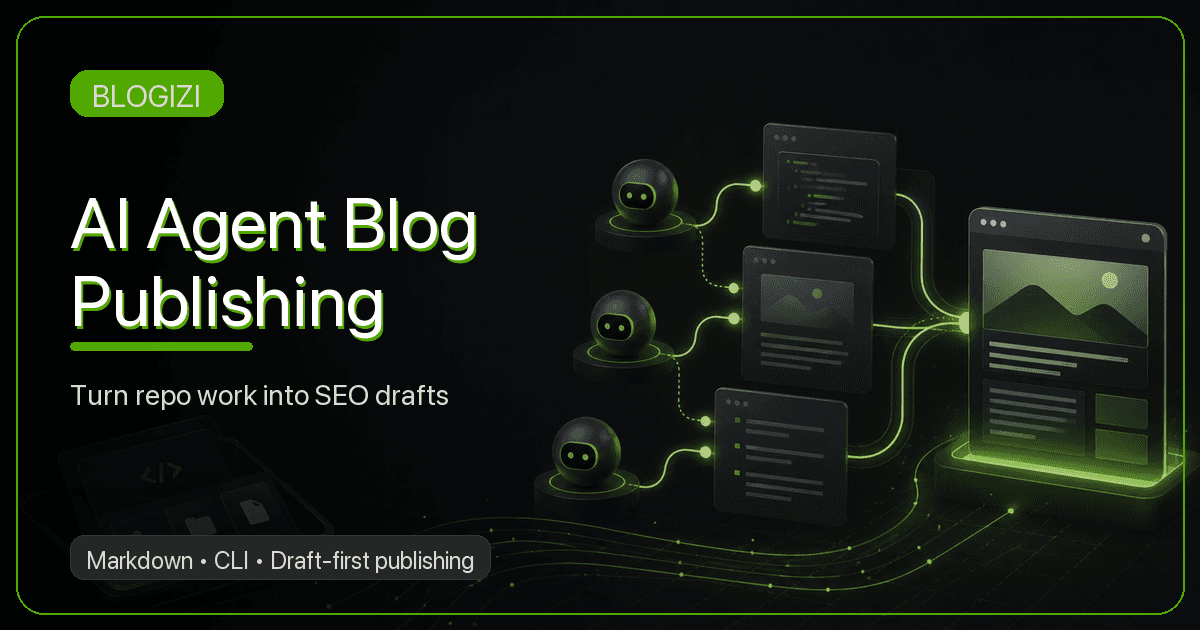
Most AI writing workflows start in the wrong place: a blank prompt asking for a generic blog post. That is why so many AI-written posts sound polished but empty. The useful version starts inside the repo, where the product decisions, API routes, docs, changelog, and actual implementation details already live.
AI agent blog publishing is the workflow of letting a coding agent inspect that context, write a Markdown draft, and stage it in your blog without jumping through a CMS. The important part is not “AI writes words.” The important part is that the draft is grounded in real work and still goes through a human review before it goes live.
This is how to set up that loop with Blogizi: repo context first, SEO intent second, Markdown as the handoff format, and blogizi draft as the safe publishing step.
What AI agent blog publishing should mean
A good agent publishing workflow has four jobs:
- Read the product or codebase before writing.
- Pick a search intent worth targeting.
- Create a reviewable Markdown file with SEO metadata.
- Stage the post as a draft, not a live article.
That last point matters. Agents are excellent at producing a first draft, but publishing should stay explicit. Blogizi's CLI is built around that separation: blogizi draft saves the post for review, blogizi update pushes revisions to the same slug, and blogizi publish is the deliberate go-live command.
If you already write in Markdown, this fits naturally. If you are still choosing a writing format, read Markdown vs Notion for blogging first — the format decision shapes the whole workflow.
Start with search intent, not a topic
The weak prompt is:
Write a blog post about our product.
The stronger prompt is:
Inspect this repo, find one useful post angle for developers searching for
"AI agent blog publishing", write a Blogizi Markdown draft, and stage it as a draft.
The second version gives the agent a job: connect a search query to real product behavior. For this post, the useful search cluster is around phrases like:
- AI agent blog publishing
- publish Markdown blog
- blogging from terminal
- Markdown blog platform
- developer blogging workflow
Those queries have slightly different intent. “Publish Markdown blog” is tool-seeking. “Blogging from terminal” is workflow-seeking. “AI agent blog publishing” is newer and narrower, but it names the direction the market is moving: agents drafting from local context and publishing through tools.
The post should answer the workflow question directly, not wander into a broad essay about AI content.
Give the agent repo access
The best source material is usually already in your project:
README.mdexplains the product in human language.- API routes show what integrations actually support.
- Components reveal positioning, objections, and feature names.
- Existing blog posts show voice, internal links, and content gaps.
- Git history shows what changed and why.
For Blogizi itself, the relevant implementation pieces are practical: a CLI that reads local Markdown, YAML frontmatter for title/description/keyword/slug, account API keys, project selection, and a hosted MCP endpoint for agent clients that prefer tools over shell commands.
That gives the agent concrete claims to make. Instead of writing “AI can streamline your content workflow,” it can write “use blogizi draft ./posts/my-post.md to stage a Markdown file as a draft, then use blogizi update after edits.” Specific beats shiny every time.
Use frontmatter as the contract
Markdown is easy for humans to review, but frontmatter is what makes it publishable. A Blogizi post starts like this:
---
title: "AI Agent Blog Publishing: Turn Repo Work Into SEO Drafts"
description: "A practical workflow for using AI agents to draft SEO blog posts from real repo context, then publish safely with Markdown, CLI commands, and reviews."
keyword: "AI agent blog publishing"
slug: "ai-agent-blog-publishing"
status: "draft"
date: "2026-08-09"
readingTime: 0
wordCount: 0
---
That block does three useful things:
- It makes SEO metadata visible before publishing.
- It keeps the slug stable across drafts and updates.
- It gives agents a structured target instead of a vague prose document.
Blogizi recalculates reading time and word count during parsing, so the agent does not need to obsess over those fields. The human should care more about the title, description, keyword, and slug.
For a broader pre-publish checklist, see the technical SEO checklist.
Keep draft, update, and publish separate
A safe workflow looks like this:
npm install -g blogizi
blogizi auth YOUR_API_KEY
blogizi use your-project-slug
Then the agent writes a local file:
blogizi draft ./posts/ai-agent-blog-publishing.md
After review, editing the same file should update the same post:
blogizi update ./posts/ai-agent-blog-publishing.md
Only when the post is ready should a human explicitly ask for publish:
blogizi publish ./posts/ai-agent-blog-publishing.md
This separation is the difference between automation and roulette. Drafting can be fast and agent-driven. Publishing should remain intentional.
Use MCP when the agent cannot run the CLI
Some agent environments cannot install global Node packages or run shell commands reliably. In that case, Blogizi also exposes hosted MCP tools with the same mental model.
The important rule is the same: do not paste API keys into chat. Put the key in the CLI config or MCP client config, then let the agent use the connected tool.
For the agent-specific setup, see Blogizi for agents. If you use Codex specifically, see Blogizi for Codex.
What to ask the agent for
The best prompts are specific about the source, audience, and publishing safety. A strong prompt looks like this:
Inspect this repo and existing blog posts. Use SEO research to pick one useful
keyword for developers. Write a Blogizi Markdown post with frontmatter in
./blogizi-posts/. Stage it with blogizi draft, but do not publish live.
If the post is about a recent feature, add the files or commits:
Draft a post about the new MCP publishing flow. Ground it in libs/mcpHandler.ts,
app/api/mcp/route.ts, and the /agent landing page. Target developers using AI
coding agents. Save as a draft only.
That gives the agent boundaries. It knows where to look, who it is writing for, and what not to do.
Common mistakes
Mistake: asking for a generic SEO article. Generic content rarely earns trust. Ask the agent to explain a real decision, bug, feature, migration, or workflow from the repo.
Mistake: changing the slug on every revision. Keep the slug stable and use blogizi update for revisions. Otherwise you create duplicate posts instead of improving the same one.
Mistake: publishing in the first pass. Stage drafts first. Review the title, description, code snippets, links, and factual claims before anything goes live.
Mistake: skipping internal links. A post should connect to related guides. For this topic, good neighbors are blogging from your terminal, how to write technical blog posts, and best developer blogging platforms.
Mistake: letting AI invent product details. The agent should inspect the codebase and docs. If a feature is not in the repo or docs, it does not belong in the post.
The workflow in one loop
Here is the repeatable version:
- Pick a narrow keyword and search intent.
- Ask the agent to inspect the repo and existing content.
- Have it write a Markdown file with Blogizi frontmatter.
- Run
blogizi draftto stage the post. - Review in the dashboard.
- Edit locally and run
blogizi update. - Publish only after an explicit go-live decision.
That is the real promise of AI agent blog publishing. Not infinite content. Not a fake thought-leadership machine quietly chewing through the internet. Just a tighter loop between the work your team is already doing and the useful explanations your future customers are already searching for.
When the agent can read the repo, write Markdown, and stage a draft safely, blogging becomes less like “content production” and more like good engineering hygiene: document the thing while the context is still warm.